

The ears are a very delicate organ, so if our animals tend to scratch frequently and intensely, they may develop various problems, from small wounds to deep injuries involving the structures inside the ear. But what causes itchy ears, and what should we do in these cases?
In certain situations or when there are ear problems, dogs and cats may react by trying in every way to relieve the discomfort or itching. The typical behaviors in these cases are two: they scratch the sides of their heads, including inside their ears, or they begin shaking their heads.
Another typical sign may be an animal pressing its head against our hand when we pet it behind the ears. In reality, this does not necessarily indicate an ear problem, because it could mean that the animal is experiencing discomfort or itching, or it could simply be a way of saying, “I like these strokes, keep going!”
If, however, we suspect that our four-legged friend may really have an ear problem, we should also look for other symptoms, such as:
-
Black earwax;
-
Abundant, foul-smelling earwax;
-
Reddened skin around the ears;
-
Hair loss around the ears;
-
Discharge of pus from the ears;
-
Small wounds and scabs outside or inside the ear;
-
Traces of blood;
-
Presence of foreign bodies in the ears.
Causes
Dogs and cats may scratch their ears especially when certain conditions or disorders are present, such as:
-
Bacterial infections: bacteria that can settle in animals’ ears include mainly Pseudomonas and Staphylococci, which often cause redness, swelling, and discomfort, eventually leading to pus;
-
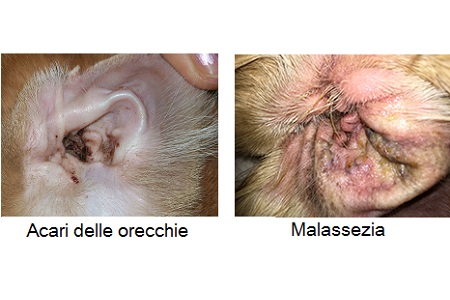
Fungal infections: some fungi and yeasts grow mainly in the body’s more humid areas, such as the ears, triggering inflammation. The main fungal infection in dogs and cats is caused by Malassezia, a yeast normally found on animals’ skin and fur, but which in some situations can grow enough to cause inflammation. The earwax is blackish and oily and gives off a particularly unpleasant odor;
-
Parasites: our animals’ ears are an ideal site for certain parasites, including ear mites, more precisely Otodectes cynotis. Their presence is called “otoacariasis” and manifests as typical blackish, dry, odorless earwax. In addition to this type of mite, auricular itching may also be caused by those responsible for notoedric mange in cats, demodicosis, and sarcoptic mange. The animal experiences intense itching and therefore tends to scratch frequently, causing lesions around the ears with its claws;
-
Foreign bodies: foreign bodies may be present inside the ear, such as the dreaded “grass awns”, fragments of wheat ears. In some cases, foreign bodies may become lodged in the ear skin, which becomes inflamed and may also develop infections. Even more serious is when foreign bodies penetrate deeply, with the risk of perforating the eardrum;
-
Food allergies and intolerances: this problem mainly manifests as inflammation of the skin or intestine. In the first case, the ears are among the most common sites and may become inflamed, making them more susceptible to bacteria, fungi, or parasites.
All these problems cause inflammation of the ear, generally referred to as otitis, regardless of the cause.
What to do
Clearly, a veterinary examination is always the first solution, especially if the symptoms become more severe over the days. We should avoid do-it-yourself treatment because, if foreign bodies are present or the animal is in pain, we could make the situation worse. The veterinarian will be able to identify the exact cause of the problem, make the correct diagnosis, and prescribe the most appropriate treatment.
If foreign bodies are present, they must be immediately removed by the veterinarian, who may ask you to administer antibiotics in the following days if an infection has already developed.
If the foreign body has damaged the eardrum, the dog or cat may hold its head to one side, shake it, and walk in an “unusual” manner. Beyond the eardrum are delicate structures that ensure proper balance, so if they are damaged, the animal may have difficulty orienting itself.
If the discomfort is caused by some infection, the veterinarian will prescribe specific medications: antibiotics for bacterial infections, antifungals for fungi and yeasts, and antiparasitic drugs for mites.
Food allergies and intolerances, on the other hand, should be treated with an appropriate change in diet, choosing single-protein or nutraceutical foods.
Tips for preventing ear problems
Dogs with long ears are more likely to develop ear problems because during meals or walks they may “collect” microorganisms, dirt, and foreign bodies that end up in their ears.
For this reason, we can use scarves or special bands to protect the dog’s ears whenever we take it out for a walk.
As a general rule for all dogs and cats, we must always make sure to keep our animals’ ears clean and, above all, dry. We should carefully pat them dry on the outside and inside if we have been to the beach or after bathing, to prevent moisture from encouraging infections.
Use specific ear-cleaning products, applying them at least once a week with a cotton swab or gauze.