
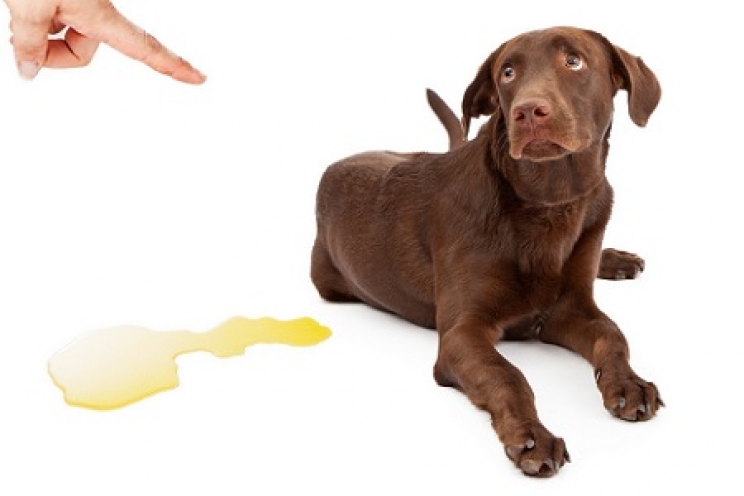
The puppy you had been eagerly awaiting has finally arrived home. You have bought everything they need, including bowls, harnesses, rhinestone leashes, little outfits, coats, and beds. Then, however, you realize that the only thing you are missing is basic knowledge about puppy training—and you realize it when, after your first night together, your home is a minefield of poop and pee in the morning. Before resorting to ineffective methods, let’s look together at how to teach your dog to go potty outside.
Things you absolutely must not do
One of the most widespread beliefs, especially among older owners, is that to teach a puppy not to soil the house, it must absolutely be punished by holding its muzzle for a long time right where it relieved itself, perhaps accompanied by a couple of spankings.
Even better, the best results are supposedly achieved with the ancient rolled-up newspaper method, which for years and years has built reinforced intestines and steel bladders. Take a good newspaper, roll it up several times, and repeatedly hit the dog while bringing it next to the place where it relieved itself.
Whether it happened moments ago or several hours earlier makes little difference. The dog understands.
Well, do not pay attention to any of this nonsense. If your grandfather tells you that all his dogs were trained with this method, tell him that it is solely thanks to the dog and not to his training methods.
In fact, all of this will be completely useless as well as counterproductive. Let’s immediately explain why.
First of all, puppies need to poop and pee very often. As a general rule, the number of hours a puppy’s bladder and intestines can “hold it” can be estimated as the animal’s age in months, plus one. Therefore, a puppy just two months old should be taken outside every three hours.
Based on this calculation, therefore, we certainly cannot blame the new arrival if, after an 8-hour work shift, the little one was unable to hold it.
Moreover, a very important aspect is negative association. By punishing the dog every time it goes potty in the house, it will never understand what the mistake is. Instead, in most cases, we will end up with a confused, insecure dog that cannot understand where to relieve itself. Worse still, it might even develop a fear of pooping and peeing because it will have associated the reprimand with the act itself.
What we want is for the dog to make a connection such as “potty outside–reward”, rather than “potty inside–punishment” or, worse still, “potty–punishment”.
Another situation we absolutely want to avoid is having the dog associate punishment with relieving itself in our presence. What could happen in these cases?
On the one hand, the dog might later refuse to relieve itself in front of us, even at the park.
On the other hand, it might even begin to eat its own feces at home so that we do not discover it!
What to do
What we should do instead is, above all, go outside more often. Keep the “holding time” rule in mind.
If you have adopted a puppy, take it outside regularly. Every time it manages to relieve itself outdoors, reward it immediately with a treat and, as soon as you return home, stimulate it even more with a long play session.
During the first period, the puppy may also need to “relieve itself” during the night. If possible, take it outside and give it the treat, but do not show too much enthusiasm and, above all, skip the play session, which could become a nighttime habit.
If you really want the dog to understand that it must not relieve itself in the house, keep it under supervision. As soon as you “catch” it, interrupt it immediately with a “No!” and go straight outside for a walk. As soon as it “goes” outside, reward it.
 If the puppy is still too young, your veterinarian will probably have advised you not to take it outside before it has completed all its vaccinations. In this case, you can try getting the puppy used to relieving itself on a puppy pad or sheets of newspaper placed on the floor. Always use positive reinforcement, rewarding it with treats when it manages to “go” on the makeshift toilet.
The important thing is that as soon as you have permission to take it to the park, you put all the necessary advice into practice to get it used to relieving itself outside, and no longer on its pad; otherwise, it could become dependent on it.
Another piece of advice is to establish a certain feeding routine as well. Arrange for meals to coincide with going outside, which is even easier with adult dogs. As for the water bowl, try removing it during the night to reduce urine production.
If it is an adult dog that simply cannot learn to go outside, or one you have just adopted, you will need to follow the same procedures, gradually reducing the number of outings over the days until reaching the ideal walks every 8 hours, that is, 3 times a day.
If the situation continues, it will be worth considering whether there are other possible causes of so-called “inappropriate elimination”. The main ones include:
-
Diet: the dog eats too much or irregularly. Make sure it has only two meals a day, preferably at breakfast and at least 3 hours before bedtime. If it has not finished its food, remove the bowls anyway;
-
Access to water: make sure it does not drink during the night by removing the bowls;
-
Food allergies and intolerances: these can cause diarrhea and intestinal inflammation;
-
Medications: a dog taking cortisone is often thirstier and therefore needs to urinate more frequently.
For this reason, if the dog continues to soil the house, start by discussing it with your veterinarian. Once they have confirmed the absence of health problems, you could consider consulting a good trainer.