

How many aspects of our daily lives would we never expect to apply to animals as well? One of them concerns the fact that dogs, cats and many other animals can be right- or left-pawed. And that is not all. It would seem, in fact, that this factor may also influence the character of our four-legged friends.
Many studies have made it possible to reach this conclusion. The first data came from careful observations of chickens in the 1970s by Australian researcher Lesley Rogers.
 Only several years later was the research extended to domestic animals, beginning with a 1991 study at Ataturk University in Turkey involving dogs and cats, and continuing with an experiment conducted solely on dogs in 2006 at the University of Manchester.
In both cases, it was established beyond doubt that our animals are also subject to the so-called principle of “lateralization”. Essentially, our brains and those of animals are divided into two halves, forming two hemispheres, right and left. Each half controls the movements and perceptions of the opposite half of the body. Thus, the right hemisphere regulates everything concerning the left side of the body, and vice versa.
Lateralization is simply the predominant development of one hemisphere over the other. The more developed half of the brain leads to greater use of the right or left side of the body—the hand, eye, ear or foot. This distinction is not always so categorical, however. Some people, for example, mainly use their right eye but write with their left hand.
Based on this phenomenon, we can therefore identify left-handed, right-handed or ambidextrous people. The same applies to our four-legged friends.
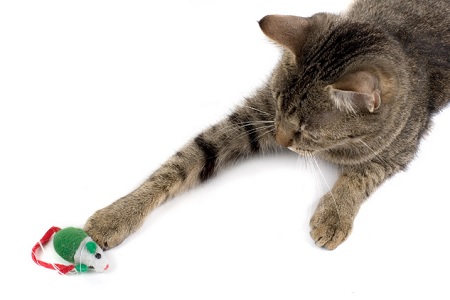
In particular, dogs and cats seem to make greater use of one of their two paws, something that can be observed while they try to catch a dangling toy. But that is not all. The same discussion can also be extended to many other voluntary movements, such as tail wagging, which has been the subject of numerous studies.
In this regard, according to a 2007 study conducted by professors from the University of Trieste and the University of Bari, the direction of the tail could also provide us with important information about the emotional state of our animals.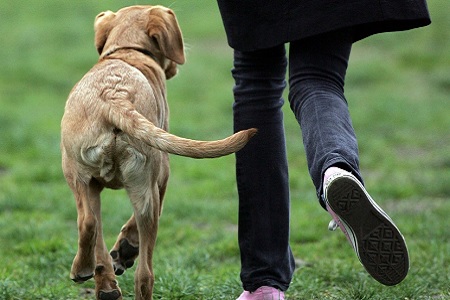
During the experiment, the dogs were first shown their owner, then a stranger and finally a threatening dog. In the first case, the animal wagged its tail intensely toward the right, as it did in the second case, though less emphatically, while in the final encounter the tail was wagged forcefully toward the left.
The explanation for this behavior could be related to the fact that emotions, rather than rationality, probably predominate in the right hemisphere, which regulates movements on the left side of the body.
Further support for this hypothesis seems to come from a study by the University of Adelaide in Australia. Australian researchers were able to demonstrate that aggressive dogs tend to be predominantly left-pawed, while more “docile” dogs are right-pawed or ambidextrous.
According to another Irish study, however, lateralization may be linked to the animal’s sex, particularly to testosterone levels. Several cats were subjected to more complex tasks. It was therefore demonstrated that during these activities males mainly used the left paw, while females used the right. This did not occur during simpler actions.
So, to unlock the thoughts of our animals, all we need to do is carefully observe which side of their body they use most.
Source: http://www.focus.it/cultura/cani-destri-gatti-mancini-e-assassini-sinistri-23477-41323