
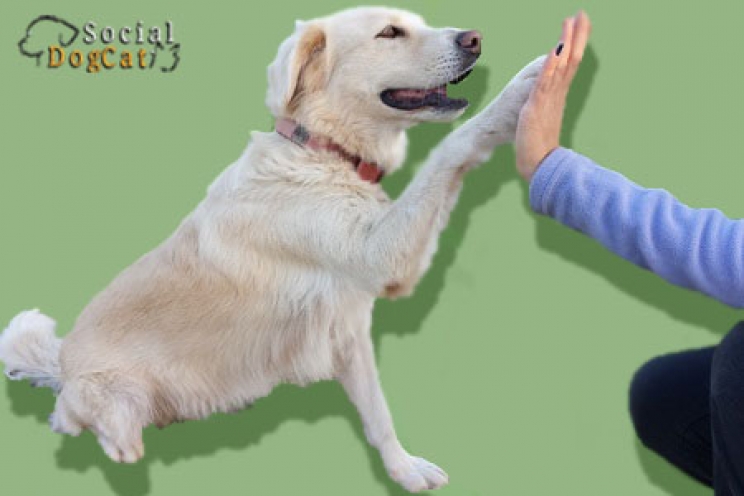
Let’s discover how to teach your dog two of the best-known commands, “paw” and “high five”.
The basics of dog training include a series of essential commands for communicating and interacting with your pet, such as the classic “sit” or “stay” command.
However, there are also others that are not strictly essential but are an excellent way to build a more enjoyable relationship with your dog. These include the “paw” command and its “high five” variation.
But how do you teach them to your dog? Let’s find out together.
Positive reinforcement
The principle underlying most educational theories is positive reinforcement.
This concept is very simple and can easily be applied to raising children as well. In practice, it consists of creating a positive thought or emotion in the dog toward a specific action.
If the dog does what we asked, we reward it with a “good boy!”, a game or a treat.
Negative reinforcement, on the other hand, is almost never considered by trainers because it is often viewed as counterproductive and useless. This principle consists of verbally punishing the dog when it does something wrong or does not do what we ask.
According to experts, scolding the dog on these occasions only arouses negative emotions, creating anxiety and concern in the animal. In this way, the dog might completely refuse the requested commands because it fears the owner’s reaction.
The “paw” command
Giving a paw is a natural gesture for dogs, used as a signal of appeasement and submission.
A puppy offers its paw to its mother when she reprimands it for doing something wrong, and dogs often do the same with their owners for the same reason. It is therefore an explicit request for forgiveness.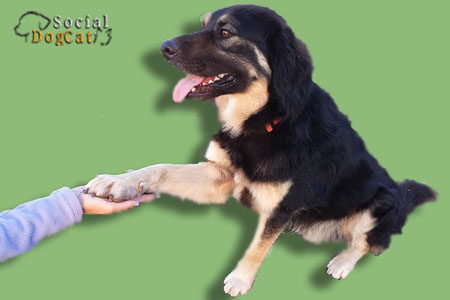
At the same time, a dog may give its paw to another dog or its owner to demonstrate submission and peaceful intentions.
Conversely, a dog that places both paws on the body of an animal or person does so out of dominance, to reinforce its superiority in the relationship.
In addition, some dogs may spontaneously offer a paw when they are seeking attention, for example if they want to play or ask for affection and food.
When we decide to teach our dog to give its paw, we must remember one fundamental point. The dog must not give us its paw spontaneously, because that is not what we asked it to do.
It must do so only in response to an explicit command; otherwise, the situation could easily degenerate into a challenge to the hierarchy or a constant demand for attention. We certainly do not want our dog to “hit” us with its paw whenever it feels like it!
To teach a dog to give its paw, simply follow a few steps, practicing calmly and patiently.
The key points for teaching the “paw” command are:
-
Choose a quiet, secluded place, perhaps when you are home alone with your dog. Initially, it will be important to gain its full concentration; only later can you try in the park or with other people;
-
Get some treats to use as rewards. Do not use the regular kibble you give every day. There are more appetizing bites or biscuits available commercially that can be offered without risking weight gain;
-
Before starting, we must already have taught our dog the “sit” command, because the dog can concentrate more easily in this position. If you have not done so yet, start with this command.
Now let’s look at the step-by-step procedure: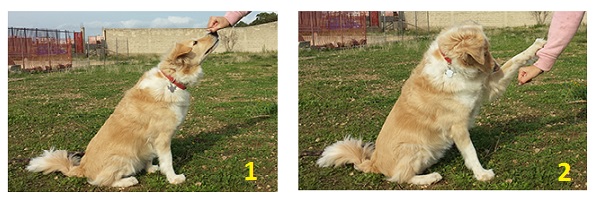
-
Once the dog is sitting, place your hand with the treat low, in front of its muzzle, slowly lowering it below the head;
-
The dog will try every way to make us open our hand, but we must remain in the same position until it places its paw on our arm;
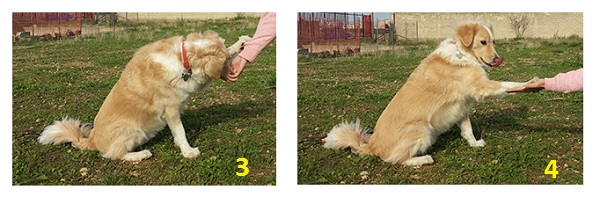
-
As soon as it touches our hand or arm, give it the treat;
-
Repeat until it offers its paw more quickly.
At this point, we can introduce the spoken command “paw” whenever we place our hand in front of its muzzle. When it touches it with its paw, give it another treat. Repeat this step several times.
Next, repeat the same procedure, gradually moving your hand farther away from the dog’s muzzle.
Only after the animal has learned these steps can we try asking for its paw without using a treat.
-
Continue holding your hand closed, but do not take the treat;
-
Place your hand in front of the dog’s muzzle, saying the spoken command “paw”;
-
When the dog gives us its paw, reward it with a “good boy!”.
Finally, we can reveal the trick by offering the dog our open hand, still without a treat. Reward it once again with praise when it performs the command.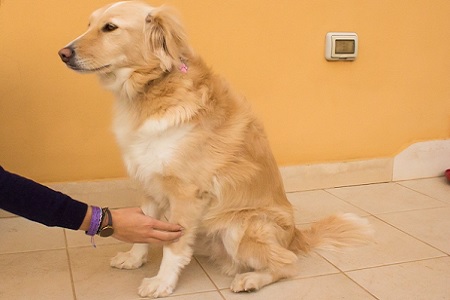
There is also another method for teaching a dog to give its paw. Let’s look at it together:
-
Hold the treat in one hand and let the dog smell it;
-
Take the dog’s paw with the other hand, saying the word “paw” each time;
-
Give it a treat, even though it has not actually done anything;
-
Repeat several times, then try again without grasping the paw, merely brushing it with your hand while saying “paw”;
-
If it offers its paw, reward it; otherwise start again;
-
Once it understands the mechanism, ask for it only verbally and reward it.
The “Other Paw” command
One variation to teach the dog after it has learned the basic command is to have it give us its other paw.
To do this, repeat the same procedure, but when it offers you its paw, keep holding it, lightly touch its other paw and reward it.
Remember to associate the spoken command “other paw” or simply “other”.
The “High Five!” command
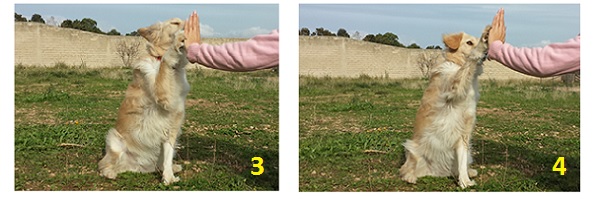
This command is a fun variation of asking for a paw. It consists of holding an open hand vertically at the level of the dog’s face; the dog must then raise its paw higher to touch our hand, just as if it were giving us a high five.
To teach the dog the “high five” command, we must already have a good foundation in the previous command.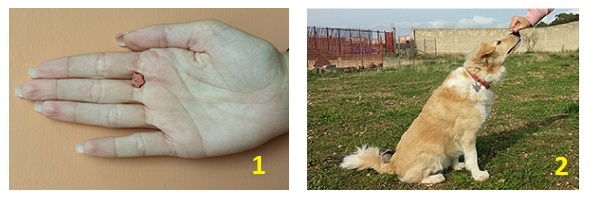
-
Wedge a treat between two fingers, keeping the hand flat;
-
Position your hand high, in front of the dog’s muzzle;
-
The dog will try to “steal” the treat, but hold firm until it touches your hand;
-
Once it has performed the command, you can give it the treat.
Repeat several times, then introduce the spoken command “high five” when you place your hand in front of its muzzle.
After the dog has learned these steps, you can continue without a reward.
If the dog cannot concentrate or perform our commands perfectly at first, do not become discouraged, but above all avoid scolding it. It would serve no purpose and would distract the dog even more from trying to listen to us.