
Among the senses of dogs and cats, sight is undoubtedly one of the most developed. Animals’ visual abilities are one of the characteristics that make them so special. Let’s try to understand how dogs and cats see and why their eyesight is so developed.
When we talk about animals’ abilities, from domestic animals to wildlife, we often try to find a scientific and rational explanation for the aspects that amaze us so much.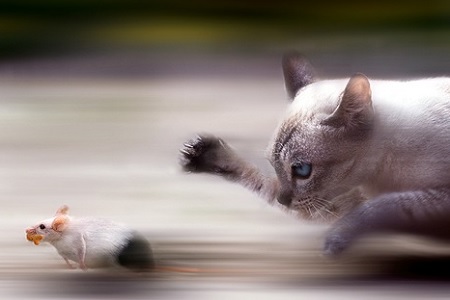
In reality, explanations can become automatic simply by considering the role each of these animals plays in nature.
Clearly, a predator must possess and develop abilities very different from those of prey.
For example, large predators in nature, such as tigers and lions, must above all be able to run quickly, jump, and focus on their prey. Their teeth and claws are developed specifically to facilitate catching prey.
Conversely, prey must have physical characteristics that allow them to flee when attacked. For this reason, they often have a lightweight body, enabling them to run very quickly. Think, for example, of antelopes or gazelles, long known for their extreme running speed.
The main aspect distinguishing prey from predators, however, is primarily related to the senses, especially sight.
Before discussing the different visual characteristics of prey and predators, let’s first look at what sight consists of and how the eyes capture images from the outside world.
How sight works
Sight is the sense that allows us to detect light coming from outside and transform it into precise images.
The eyes are the organs specialized for this task, but to function correctly they must work together with the nerves and brain.
The eye is a spherical organ located inside the skull, specifically in the eye sockets. It consists of various internal and external parts: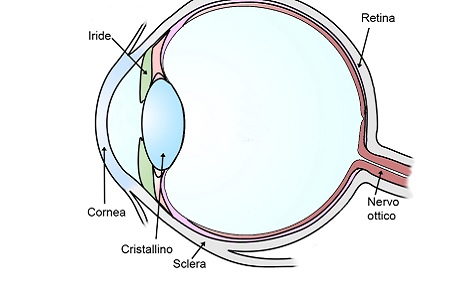
- Cornea: a thin, transparent layer covering the outermost part of the eye. In reality, the cornea is the smallest portion of the outer covering, because laterally and posteriorly it is called the sclera;
-
Iris: the colored part of the eye, located at the front beneath the cornea;
-
Pupil: the black dot in the center of the eye. In reality, it is simply a small opening in the center of the iris;
-
Lens: located immediately behind the pupil and iris. It is very important because it acts as the eye’s lens, allowing images to be focused by continually curving and reshaping itself;
-
Retina: the inner lining of the eye. It is found only at the back of the eyeball, so it cannot be seen from the outside. It is a fundamental part of the eye because it contains rods and cones, structures essential for sending stimuli to the optic nerve, which lies at the center of the eye and passes through the retina. It is crossed by blood vessels and nerves;
-
Cones and rods: the proper definition of these structures is “photoreceptors,” precisely because they receive light and transform it into electrical energy transmitted to the nerves. Cones are responsible for detailed color vision, while rods are responsible for seeing shades of gray in darkness and in motion;
-
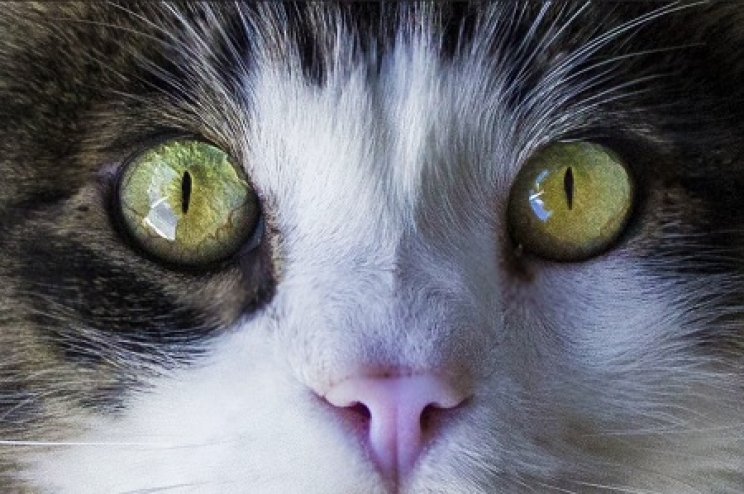
Tapetum lucidum: this structure is not present in humans, but only in cats, dogs, and other animals. Have you ever noticed the strange effect produced when photographing a cat with a flash? The eyes become extremely bright, just like a car’s high beams. This phenomenon is due precisely to the presence of the tapetum lucidum. It is a thin layer located inside or immediately behind the retina. It has highly reflective properties, enabling it to reflect light entering the eye back toward the retina, thereby increasing the light stimulus so that more images can be perceived even at night. The effect is the same as directing a lamp toward a small mirror.
When light enters the eye, it passes through the pupil until it reaches the back of the eye. The cones and rods in the retina therefore capture light and transform it into electrical energy that travels along the optic nerve.
 This nerve connects the eye to the brain, carrying the stimulus to that point. Once it leaves the eyeball, the optic nerve crosses at the so-called “optic chiasm,” where the image captured by the left eye “travels” toward the right half of the brain, and vice versa.
Once the electrical stimulus that has passed through the two optic nerves reaches the brain, it is transformed into an image, as we continuously perceive it.
The brain must process the resulting image, calculating a long series of aspects. These include, above all, depth, which allows it to assess how far away we are from each individual object in the image.
All this is possible because our vision is called “binocular” or “stereoscopic”. Although close to each other, the eyes are positioned at two different points, so the image captured by one eye will necessarily differ from that perceived by the other. Conversely, “monocular” vision is when only one eye can perceive part of the visual field while the other cannot, due to strabismus or the position of the eyes on the head.
The brain merges the two images obtained only if they are identical, processes them, and calculates the depth and position of individual objects. For this to happen, the eyes must be able to look at exactly the same point simultaneously, which is why depth is not detected in monocular vision.
Vision in prey
As for prey, their vision has characteristics that primarily help them locate an approaching threat. The main characteristics include:
-
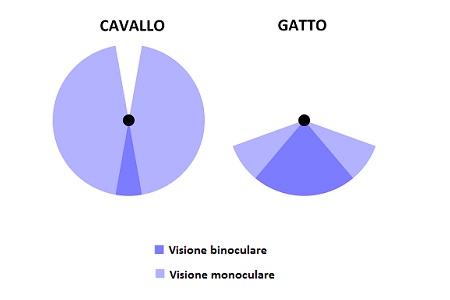
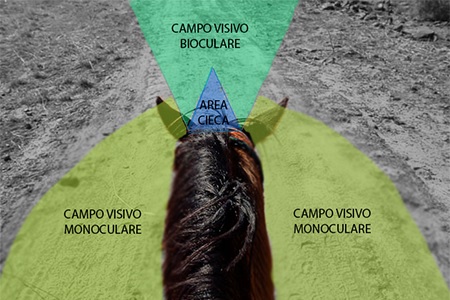
Eyes positioned laterally on the face: this gives them panoramic vision of their surroundings, with a visual field of almost 350°, clearly greater than our “meager” 180°;
-
Lateral monocular vision: to have a wider visual field, prey animals’ eyes must “sacrifice” stereoscopic vision in favor of flat, depthless monocular vision. This means that, with their eyes positioned laterally, each eye can expand the visual field without being supplemented by the other. The brain therefore does not have two identical images to overlap and process, so it cannot precisely calculate the depth and distance of objects, except across a minimal portion of the visual field;
-
Anterior binocular vision: in prey, stereoscopic or binocular vision—the more precise type—covers only 70° of the anterior visual field. Although this is actually limited, it is more than sufficient to identify and distinguish the plants they can feed on;
-
Blind spots: some prey animals have a muzzle that projects particularly far forward and downward, as in horses and other herbivores. This inevitably creates “blind” areas, meaning parts of the visual field that cannot be perceived in any way. This area corresponds to a small triangular section immediately in front of the animal’s muzzle, precisely the portion of the visual field where binocular vision should operate.
Although it may seem disadvantageous, the combination of these features is actually beneficial for prey. The broad visual field allows them to see dangers even when the animal is busy eating, for example.
At the same time, predominantly monocular vision, which does not allow precise perception of depth, creates a certain tension whenever the animal detects movement or an unusual object, making it more ready to flee.
The classic example is the horse, which, despite its large size, is still prey. Anyone who has spent even a few minutes with a horse will surely have noticed its large, laterally positioned eyes. If we stand beside a horse, we get the impression that it can see us without moving its head.
This is precisely due to its broad monocular vision, which allows it to see everything at its sides.
Another characteristic of the horse is that it is easily frightened whenever an unfamiliar object enters its visual field or it detects movement. The reason for its fear is precisely its inability to perceive distances between objects well, so if a small dog crosses our path a few meters away, the horse might perceive it as movement that is too close.
This would immediately cause considerable tension in the horse, stimulating its flight reflex. It may not be a small dog, but in nature this response could save its life from the threat of a much fiercer predator.
Vision in predators
Let us now turn to the vision of predators, which also include our dogs and cats.
Predators are born with their eyes sealed shut, opening them and completing visual development only after several weeks. They also cannot walk, but move by wriggling in search of their mother’s warmth and purring. This mechanism helps mothers keep them safe when they leave to hunt. A blind puppy will be unable to move, so it will remain close to the other puppies until its mother returns.
Conversely, prey are born already standing and with their eyes open, ready to flee from the first days of life in case of danger.
Predators’ vision is also developed in a way that allows them to locate prey in any geographical or lighting condition. For this reason, they have very specific characteristics, such as: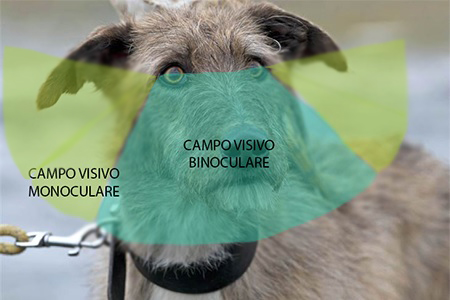
-
Well-developed night vision: predators can see well both during the day and at night because they have a greater number of rods. In cats, rods number as many as 200 million, while humans have “only” 120 million. The result is a nighttime image in shades of gray, much more intense and detailed than ours;
-
Eyes positioned centrally on the face: this allows predators to focus on a precise point in the visual field;
-
Wide visual field: prey certainly have a considerably wider field, but predators are not far behind. In dogs and cats, the visual field can reach 270°, with higher values especially in those with flat faces;
-
Greater stereoscopic vision: this means that predators’ eyes can better assess the distance separating them from their prey;
-
Vision more sensitive to movement: predators can instantly perceive even the slightest movement of prey, even at long distances, because they have a greater number of rods, which serve not only to see in the dark but also to detect movement;
-
Greater sensitivity to light: some predators, especially felines, can adjust the structure of the eye according to the amount of available light, thanks to two features: the flexible pupil and the tapetum lucidum. The cat is an excellent example of both features, which are also present in dogs. When ambient light is very strong, the cat’s pupil narrows until it becomes a slit because the light could make the image dazzling and poorly detailed. Conversely, as evening approaches, the pupils begin to open to let in more light and see images better.
Differences between dog and cat vision
In reality, the differences are very small.
Dogs and cats mainly differ in their ability to regulate light and identify colors.
We said that light is regulated by the pupil and the tapetum lucidum. In cats, both elements are considerably more developed than in dogs, so they can see sharper images even in darkness or when light is scarce.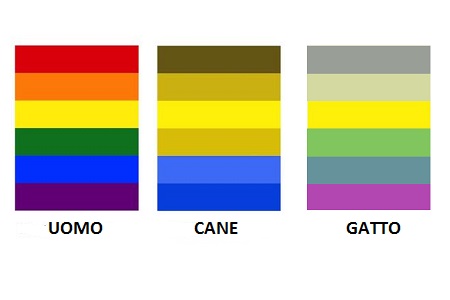
Furthermore, although dogs and cats both have remarkable eyesight, they perceive fewer details than humans under optimal lighting conditions. This means that during the day they can see even the slightest movement, but they cannot produce a sharp, detailed image of something only a few centimeters away.
Here too, this makes sense when we consider that dogs and cats are nocturnal animals, so it is more advantageous for them to locate prey during nighttime hunting.
Both animals also have more rods than cones, unlike humans. For this reason, they are formidable at seeing in the dark and reacting to the first movement of their favorite toy, but they cannot perceive the same range of colors as our eyes.
Dogs can distinctly perceive blue-violet and yellow. Conversely, they recognize all shades from red to orange to green only as different from white, but confuse them with yellow. All other colors are not perceived.
Cats, on the other hand, can distinctly see 3 colors: blue-violet, yellow, and green, so they will not perceive, for example, red.
The explanation for these “shortcomings” is always found in nature. Most prey animals have beige, brown, or gray coats, so what use would it be for our dogs and cats to perceive a vivid fuchsia?