
One of the most frequent questions owners ask veterinarians is “why does my dog drag its bottom on the ground?”. Let us examine the causes that prompt dogs to make this movement, and what can be done to prevent it.
This behavior is known in medical terminology as the “scooting” movement. The dog plants its hind legs on the floor, moves its pelvis forward, and moves using its front legs, rubbing its bottom on the ground, as if it were dragging a wheelbarrow.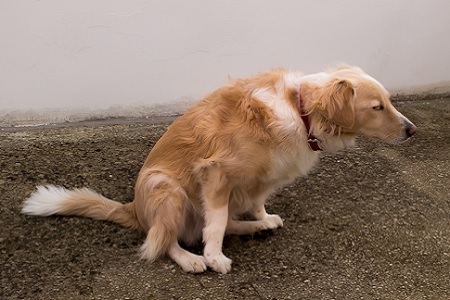
When a dog makes this movement, some owners may become alarmed, although in most cases it is not a worrying situation. The dog may drag its bottom on the ground simply because it is itchy or uncomfortable, but it may also experience pain.
In any case, there may be several reasons behind this behavior, so it is important to consult your veterinarian right away to rule out more serious problems.
The main causes that may lead an animal to drag its bottom on the ground are primarily two medical conditions:
-
Intestinal parasites
-
Full or inflamed anal glands
Intestinal parasites
In the first case, the intestinal parasite that can usually cause severe itching around the anus is the tapeworm. Its scientific name is Dipylidium caninum, and it is a parasite from the same family as the so-called “solitary worm” in humans.
Tapeworms can normally live inside fleas, which in turn can infest dogs. If a dog accidentally swallows a flea while licking itself, it may also introduce the tapeworm hosted by the flea into its stomach. In this way, the tapeworm can “move” from the flea to the dog, feeding on what the animal ingests and reproducing inside the intestine.
Once reproduction has occurred, the tapeworm may release eggs, enclosed within the “proglottid,” a sac-shaped structure capable of moving along the dog’s intestine. When the infestation becomes particularly severe, these proglottids are eliminated with the feces and may even be visible to the naked eye.
Examining the area around the anus of a dog infested with tapeworms, one may notice small whitish structures, similar to grains of rice.
The main symptoms associated with the presence of tapeworms may include:
-
Diarrhea;
-
Vomiting;
-
Parasites in the vomit;
-
Weight loss;
-
Constant appetite;
-
Anal itching;
-
Rough, dull coat.
For this reason, if the dog feels itchy around the anus, it will try every possible way to scratch itself, and what better way than rubbing its bottom against the floor?
Inflammation of the anal glands
The second main cause of scooting is full or inflamed anal glands.
These glands are two small sacs located on either side of the anus. Their function is to produce and release a thick, foul-smelling substance that softens the feces and makes them easier to expel.
 Another function of this substance is to allow the dog to mark its territory. This is why dogs always sniff other animals’ feces before managing to do their own “business.” The lubricating liquid produced by the anal glands acts as an identifying stamp that the dog applies to signal that the feces are its own.
The dog may also release this substance when it is overly excited and agitated.
Under normal conditions, the anal glands empty each time feces pass through, so regular intestinal transit helps keep them active and clean.
However, the glands may fail to empty completely, and the liquid they produce accumulates inside them, causing inflammation.
Over time, bacteria may grow inside the liquid, so the inflammation may turn into a true infection, with even more serious consequences.
When bacteria are present, the ducts that allow the liquid produced by the glands to escape become blocked, so all the material present accumulates inside in increasing amounts. The body then attempts to solve the problem by “digging” through everything surrounding it, such as muscles, creating cavities called “abscesses” or channels called “fistulas.”
The causes of anal gland problems include a range of conditions, including:
-
Frequent diarrhea;
-
Prolonged constipation;
-
Excessive production of sex hormones;
-
Food intolerances;
-
Anal gland tumors.
Symptoms that may occur in cases of anal gland obstruction or infection include:
-
The dog drags its bottom on the ground;
-
The dog licks or bites the area under its tail;
-
It often assumes a position as if it needs to defecate;
-
It cannot sit down;
-
The area around the anus is swollen, warm, and red;
-
It may have a fever.
What to do if the dog drags its bottom on the ground
First, you should consult your veterinarian, who can determine the source of the problem.
Through simple stool tests, the veterinarian can assess the presence of intestinal parasites. In this case, treatment involves administering specific medications orally, by injection, or as a spot-on.
In addition to drug therapy, prevention must also be considered. It is very important to eliminate all factors and situations that may expose our animals to fleas.
The flea and tick treatment must be applied regularly once a month. You should also wash and disinfect all washable surfaces in the house, including carpets, cushions, sheets, and sofa covers. Just a few flea eggs scattered around the house are enough to put our animal at risk again.
Through a careful examination of the anal area, the veterinarian can instead examine the anal glands. 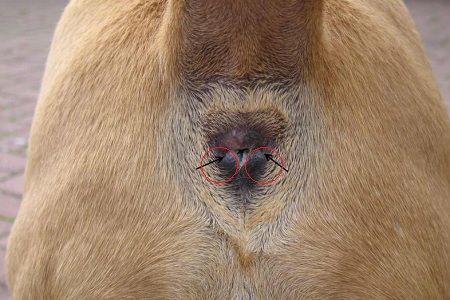
If they are simply blocked, they will need to be manually emptied. This is a procedure you can also perform yourself with some practice.
-
Put on latex gloves and take some gauze or paper towels;
-
Lift your dog’s tail and locate the glands. If they are blocked or inflamed, they will most likely be swollen, making them easier to find. A very useful technique is to imagine the dog’s bottom as a clock. The glands are located precisely at 4 and 8 o’clock, in the lower lateral area of the anus;
-
Squeeze them very gently using the gauze until you notice a particularly foul-smelling liquid coming out;
-
At the end of this procedure, you can wash the dog’s bottom with a specific cleanser to remove any traces of liquid and the unpleasant odor.
If during the examination the veterinarian notices an infection, it will be necessary to administer antibiotics and possibly perform surgery to remove the infected material. In the most serious cases and when recurrences occur, the veterinarian may decide to surgically remove the glands.
If the dog is healthy, manual emptying should not be necessary. Occasional episodes, a maximum of two or three times a year, may nevertheless be considered normal, especially if the dog is not neutered or has irregular intestinal transit. Otherwise, you should consult your veterinarian.