
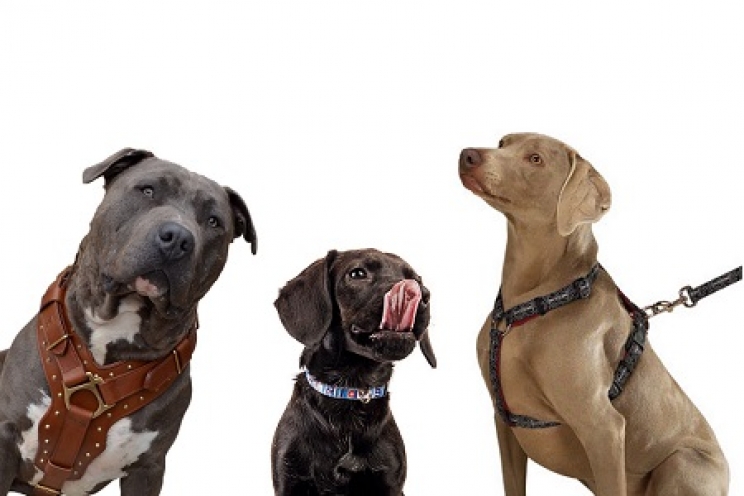
Among the essential accessories for a dog, the collar or harness is one of the most important. Sometimes choosing one or the other is not so simple. Let’s look together at the pros and cons of collars and harnesses from an educational, practical and ethical point of view.
When adopting a puppy, or even if our companion has never been properly trained, we almost always have to deal with a typical situation: the dog that pulls on the leash.
In these cases, the first thing to do is undoubtedly to apply the training methods recommended by experts. However, the choice of collar or harness can still have a significant effect on this aspect.
To understand which of the two accessories is more suitable, we must first know the characteristics that distinguish them and their respective pros and cons.
The flat or webbing collar
The collar has always been the most commonly used accessory for dogs living indoors or outdoors. It is easier to put on and may be more easily tolerated by the dog, so much so that almost all owners now avoid even taking it off, including at home.
The collar is considerably smaller than a harness. There are collars of different types, shapes and materials, but essentially they are very similar.
The traditional collar is still the most widely used today. It consists of the classic strip of fabric, nylon, leather or leather fastened according to the size of the animal’s neck with a convenient buckle.
This type of collar should be fitted so that it is neither too loose, allowing the dog to slip out of it, nor too tight, preventing it from breathing. In theory, there should be about two fingers between the dog’s neck and the collar.
The advantages of a flat collar are certainly its ease of application and the fact that it can safely be left around the dog’s neck all day, perhaps with an identification tag in case the dog gets lost.
From a practical standpoint during walks, a flat collar is excellent especially for calmer dogs, already accustomed to staying beside their owner.
It is not recommended, however, for overly exuberant dogs, because they could easily slip out of it by pulling backward and could hurt themselves if they pulled on the leash.
In summary, then, let’s look at the pros and cons of a flat collar.
The pros include:
-
Easy to put on;
-
Can always be kept around the dog’s neck;
-
No particular restrictions based on the dog’s age or size;
-
If we want to turn the dog’s gaze away from a danger or stressful situation, we can turn its head in the direction we prefer.
The cons are:
-
Can slip off easily;
-
The right width for the dog’s neck must be determined;
-
Can damage or pull out the fur.
The choke or slip collar
Another type of collar, used less often, is the so-called “choke” collar. It is a particular metal accessory without an actual closure, which tightens like a noose around the dog’s neck when it pulls too hard on the leash.
Opinions about its use are decidedly conflicting.
In fact, the choke collar allows an overly exuberant dog to be restrained when it tends to drag its owner during walks. When the dog pulls, the noose tightens around its neck, creating a negative sensation that will automatically be associated with the act of pulling.
At the same time, however, it can be harmful and is regarded by many owners and trainers as a form of mistreatment of the dog. Various claims circulate about hypothetical injuries and health problems that some dogs may have suffered precisely because of using this collar.
 As with everything, however, both sides of the issue should always be considered. A choke collar should never be used improperly. This means that if the owner were to pull the leash excessively and repeatedly, it is clear that the dog would be hurt because it would have no way to free itself.
The same thing can happen if the owner forcefully jerks the leash or engages in a sort of tug-of-war with the dog.
In reality, there are many schools of thought according to which a choke collar can instead be useful, especially in certain cases.
Generally speaking, it should be noted that a collar of this type is absolutely not recommended for puppies and small dogs. These dogs do not have a frame and musculature sufficiently developed to withstand pressure from the collar on the neck, so they may experience discomfort and pain.
According to some trainers, large dogs and molosser breeds, on the other hand, might be ideal candidates for a choke collar, given their proportions and physical strength.
In practice, a choke collar should not be used as the main training method to teach a dog to walk beside its owner. Instead, it should only be chosen for adult dogs that have already received basic training to avoid pulling on the leash.
In conclusion, the pros of a choke collar include:
-
Prevents the dog from pulling;
-
Does not pull out or crush the fur;
-
Does not slip off if the dog pulls backward or jerks.
The cons include:
-
It must be used sensibly and appropriately;
-
If we need to restrain the dog in an emergency, it could be hurt and frightened, pulling even harder;
-
It is not suitable for dogs with respiratory or heart problems;
-
It is not suitable for puppies or small dogs.
In proportion, however, considerably more canine trainers are horrified at the mere sight of a choke collar because they consider it a cruel “shortcut” for teaching a dog not to pull, contrary to all modern training principles.
The “X-shaped” or scapular harness
The “X-shaped” or scapular harness was the first to be introduced on the market. The straps are arranged to create two openings into which the dog’s front legs are inserted, then join over the dog’s back with a buckle.
It is easy to put on, costs less than other harnesses and is normally well tolerated by the dog.
This type of harness, however, has a significant disadvantage. The strap passes immediately behind the elbows and rises along the shoulder blades, so it can cause rubbing on the animal’s fur and skin. It also tends to inflame the glands located in the armpit area.
Another negative aspect of the “X-shaped” harness is that, by encircling the animal’s elbows, it causes the front legs to spread farther apart, producing an unattractive gait and appearance and potentially harming the joints.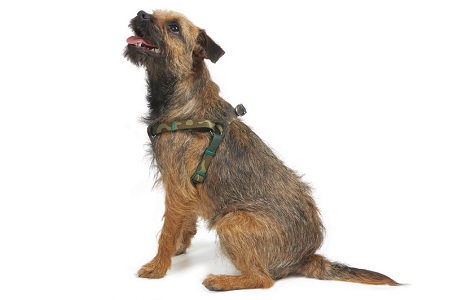
From an educational standpoint, the dog will also feel freer to pull because the physical force is concentrated precisely on the legs.
The pros of the scapular harness include:
-
Easy to put on for those with some experience;
-
Does not tighten around the dog’s neck;
-
If the puppy or small dog is in danger, we can lift it and hold it in our arms without effort.
The cons of the “X-shaped” harness include:
-
Presses against the dog’s shoulder blades, causing rubbing and irritation;
-
Spreads the elbows;
-
The dog pulls more easily.
The “H-shaped” or Swedish harness
The “H-shaped” harness is gradually replacing the “X-shaped” one. Compared with the latter, it embraces the dog’s chest more evenly, without passing over the elbow area.
The straps of the “H-shaped” harness are arranged to form two loops connected by a strip of fabric that rests on the dog’s back and another on its chest.
The buckle connecting the various straps is located on the rear loop, which should be positioned exactly where the animal’s chest ends. Some models instead have two buckles located at the sides of the trunk.
It is put on by passing the front loop over the dog’s head, then inserting the legs into the two lower openings. Finally, the chest is encircled with the rear loop and the buckle is fastened.
The hook for attaching the leash is located exactly halfway along the dog’s back, so if it pulls, the weight is distributed across the entire body, facilitating the owner’s training efforts.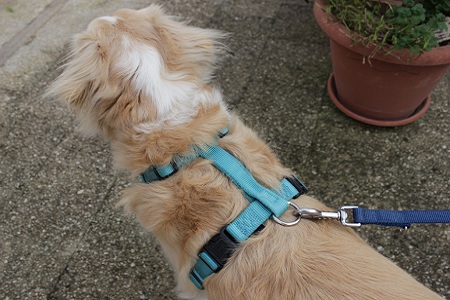
According to most trainers and veterinarians, the “H-shaped” harness is the best choice, because it leaves the dog’s neck free while providing a firmer hold without damaging any part of the animal’s body.
The pros:
-
Especially suitable for puppies;
-
Leaves the elbows and neck free;
-
Excellent for running or cycling with the dog;
-
If the dog pulls, it will not be harmed.
-
Allows the owner to restrain the dog effortlessly;
-
Gives the dog greater freedom to socialize.
The cons:
- Putting it on takes more time.
As you can see from the list of pros and cons, it is clear why this harness is currently the preferred choice of many owners.
In conclusion, it is important to remember that if our goal is to teach our dog not to pull on the leash, before choosing a collar or harness we must first address the root of the problem with suitable training methods.
No collar or harness can take the place of good training, so first put all the advice for teaching your dog not to pull into practice, and if that is not sufficient, consult an expert in the field.