
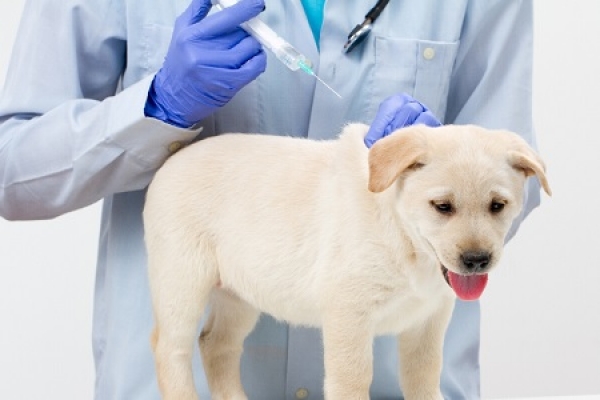
In this article we will explain how to give injections to dogs and cats, especially subcutaneous, intramuscular, and insulin injections.
Among the various types of medication, injections are certainly the least commonly administered by pet owners, who instead prefer tablets and syrups. However, it may happen that a dog or cat urgently needs an injection or fairly lengthy treatment, so being able to help them would be useful.
Giving a subcutaneous injection
Subcutaneous injections are certainly the most widely used. They are used to administer most medications, from vaccines to anti-inflammatory drugs, and even for some IV fluids.
For subcutaneous injections, the preferred area is between the shoulder blades, which is less sensitive and thinner than other parts of the body. This point is undoubtedly easier to handle, thanks to the abundant layer of skin covering it, and also because the animal cannot see what you are doing.
To administer subcutaneous injections, you can use different types of needles and syringes, so follow your veterinarian’s instructions.
Once you have drawn the medication into the syringe, remove all the air. Gently tap the syringe with your fingernail so that the air bubbles rise toward the needle, then push the plunger to expel them.
During this operation, the amount of medication indicated by the pre-printed graduations may decrease, so always check that you have the correct dose.
At this point, lift the skin with your fingers between the shoulder blades, and use your index finger to identify the exact point where you will insert the needle.
Take the syringe and position it so that it is perfectly parallel to the animal’s body. Insert the needle until it reaches the “empty” space between the two skin folds. Do not use excessive force, because you could easily pass through the skin. The animal will not be hurt, but you will have wasted the medication.
Push the plunger at an appropriate speed. Cats tend to wriggle or attack more easily than dogs, so you will need to be very quick.
Withdraw the syringe and do not massage, especially if you are giving an injection to a cat. Massaging immediately after injecting medication is among the risk factors for injection-site sarcoma.
Giving an intramuscular injection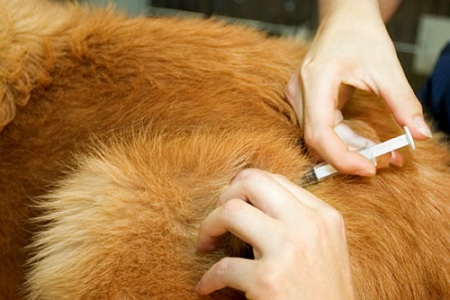
As for intramuscular injections, it is preferable to administer them in the buttock, just as with people, more precisely between the pelvis and the knee, where the muscle can be felt.
Intramuscular injections are used less frequently, mostly by veterinarians, for example to administer a tranquilizer or other medications.
This is a more complex procedure than subcutaneous injections because you must perform one additional step. There are blood vessels in the muscle that can easily be pierced by the needle. The medication must not be injected into a vessel when the injection site is the muscle.
Therefore, once the needle has been inserted, you must slightly pull back the plunger. If the medication in the syringe turns pink, it means that you have “hit” a blood vessel.
In this case, you must repeat the entire procedure from the beginning and use a new syringe and new medication.
If, instead, you have avoided the blood vessels, push the plunger quickly. Some medications can cause a certain burning sensation in the muscle, so the animal may react negatively before you manage to inject the entire contents of the syringe.
Giving insulin injections
Unfortunately, the number of diabetic dogs and cats is steadily
increasing, especially because obesity and insufficient physical activity are increasingly common.
Owners of a diabetic animal know that administering insulin is a commitment that must be followed consistently and rigorously every day. Naturally, it would make no sense to take the animal to the veterinarian several times a day for an injection that is actually very simple to administer.
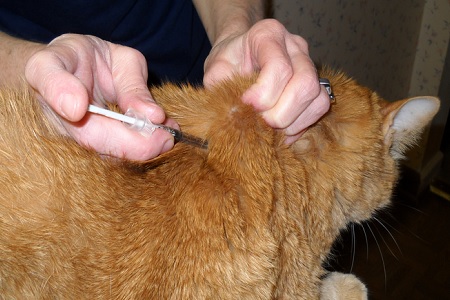
For this reason, you can begin giving insulin injections yourself.
Take the insulin vial from the refrigerator, where it should be stored continuously, and try to mix the medication without shaking it. Slowly turn the vial over several times so that it mixes without damaging the delicate medication inside.
Draw the correct dose with a dedicated insulin syringe as indicated by your veterinarian. Remove the air bubbles by gently agitating the syringe and pushing the plunger.
If the medication level has changed while performing this operation, draw more from the vial.
If your veterinarian considers it appropriate, mix the insulin with the correct amount of saline solution. Always remember to follow the prescription, because diabetes is a serious and complex disease, for which the slightest distraction can compromise the animal’s health.
At this point, you can proceed as with a normal subcutaneous injection, between the shoulder blades but also on the shoulders, flank, or other parts of the animal’s body.
In any case, regardless of the type of injection, try to avoid improvisation and fanciful techniques. The first time, ask your veterinarian to show you how it is done, to be sure you are acting correctly.