
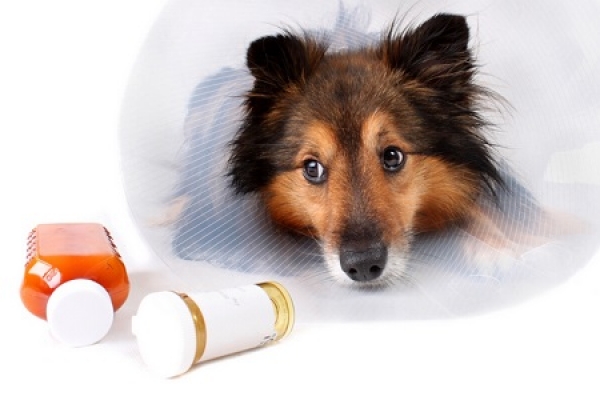
When a dog or cat needs daily treatment, it is not always necessary to take them to the vet every time; you can also learn the correct techniques for administering tablets yourself.
If your companion needs urgent treatment, and your vet agrees, you may be able to do it yourself without wasting any more time.
Tablets are often prescribed for long-term treatments to be followed several times a day. For this reason, it can be very useful to learn how to administer them yourself.
Generally, it is easier to give tablets to a dog than to a cat. Cats can be very clever and wary, and they also have a highly selective and suspicious palate. Dogs, on the other hand, are often rather gullible, making them easier to fool.
The deception method
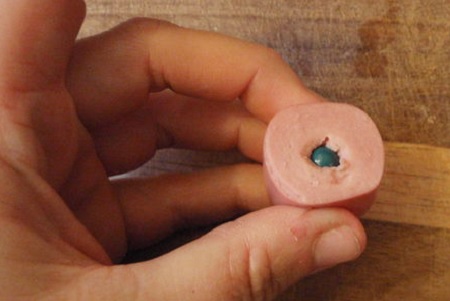
The first method is to hide the tablet in food. Choose your animal’s favourite food and make sure the tablet is well concealed inside it. Dog owners usually prefer to use sausages or meatballs, or something large enough to insert the tablet into.
This technique works with most dogs, but it may be more difficult with cats.
Cats are extremely habitual in their food preferences, so even changing the brand of kibble may cause them to go on hunger strike. Imagine if they detected a different smell in their food.
For cats, therefore, an option may be to finely crush the tablet, mixing it into purée or their favourite food.
The “filled” syringe technique
If the deception technique does not work, you can try using a needle-free syringe, “filled” with purée.
Finely crush the tablet and mix it with room-temperature water and a little diluted purée. Try to make the mixture liquid enough to pass through the syringe opening, but we advise against using water alone, because it could easily go down the wrong way.
Hold the animal’s head still with one hand and, with the other, position the syringe at the side of the mouth, in the free space just behind the canine teeth. Slowly and gradually press in the purée, waiting for the animal to swallow. Continue until all the mixture has been administered.
Using force
If this technique does not work either, it may be time to use force. You will have to place the tablet directly in the animal’s mouth.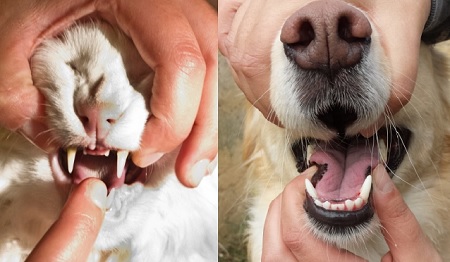
The procedure is slightly different for dogs and cats because of differences in anatomical structure and temperament. Cats scratch, while dogs bite, so you will need to know how to protect yourself in both cases.
To give a tablet to a cat, hold it with two fingers. With your left hand, hold the head on both sides. The index finger of your right hand should be placed centrally on the lower incisors, pushing the jaw down. Once the cat has opened its mouth, place the tablet on the tongue and push it deep inside with your index finger.
To prevent the cat from spitting it out, try to make it keep its mouth closed, using both hands, and gently massage its throat to stimulate swallowing.
With a dog, on the other hand, the left hand holds the head still, with the middle finger and thumb on the sides of the jaw, taking care to cover the teeth with the skin just behind the canine teeth. This will prevent the dog from biting you. At the same time, the right hand grasps the lower jaw, wrapping the palm around it, and uses the same method to lower it by pressing the skin against the teeth.
Always massage the throat to facilitate swallowing.
The pill gun technique
If you are not confident or are afraid that your index finger might end up in the dog’s or cat’s stomach, you can obtain a pill gun. This small plastic instrument has a compartment for tablets and a sort of syringe that allows you to reach the deepest part of the animal’s mouth, “shooting” the tablet directly into the throat.
The moisturiser technique
With cats, you can also try another remedy: smear the crushed tablet on the fur, just as if you were applying moisturiser. Cats hate being dirty, so they will agree to lick the medicine simply to become clean and fragrant again.
Finely crush the tablet and mix it with the usual hairball-removal paste or anchovy paste. Choose whichever you prefer, provided it is thick and sticky. Spread it on the animal’s paw or rub it around its muzzle.
There are many techniques for administering tablets to our animals. However, you will not always manage to put them into practice successfully on the first attempt. After several spat-out tablets rendered unusable, kilos of wasted sausages and various struggles ending in scratches, you will probably have acquired enough knowledge to become a true expert at giving tablets to dogs and cats.