

Many of us have only a general understanding of the term “heat” and will surely have seen or heard a female dog or cat during mating season. However, not everyone knows exactly what heat is, why it occurs or how to behave if their animal is going through this delicate phase.
First, a fundamental concept must be clarified. In women, female dogs, female cats and females of all other species, periodic changes occur that enable mating and therefore fertilisation.
However, each species has very different characteristics throughout all these stages, from reaching sexual maturity to ovulation and reproduction.
Sexual maturity
Sexual maturity, to begin with, is the period from which the female’s body is ready to initiate and sustain pregnancy.
In women, this is more precisely called puberty and occurs with the so-called “development”. The body changes externally and internally, so the female reproductive system begins to activate, producing all the hormones needed to prepare for pregnancy.
Animals also reach sexual maturity, at different times depending on the species.
While in women it usually occurs by age 12-13, in female dogs and cats it generally begins at around 6-8 months.
From this period onwards, females of all species begin to experience what is known as the “estrous cycle”, which differs from the woman’s menstrual cycle.
Both nevertheless involve changes in the balance of sex hormones, namely those involved in the reproductive system, occurring at different intervals in women and animals.
The woman’s menstrual cycle
The woman’s menstrual cycle has a total duration of 28 days. The first day coincides with the onset of menstruation, the familiar monthly bleeding experienced by all women. During the following 14 days, egg cells grow and develop inside the ovaries; they will give rise to a foetus only if reached by the male’s sperm. On the fourteenth day, ovulation occurs: the egg cell is released from the ovary and prepares to be fertilised by sperm.
At this point, two situations may occur.
If fertilisation occurs, the egg cell implants in the uterus and continues growing until it develops into a foetus.
If fertilisation does not occur, the egg cell is no longer useful, so it becomes what is known as the “corpus luteum”, which is then eliminated as a new cycle begins.
The female dog’s estrous cycle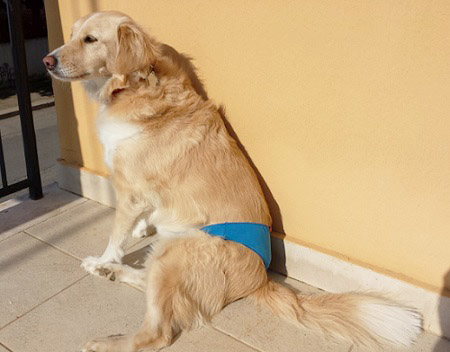
The female dog’s estrous cycle occurs very differently from the woman’s menstrual cycle. Four stages can be distinguished, with very specific events:
-
Proestrus: the egg cell begins to mature. Light bleeding appears from the vagina, but not for the same reasons as menstruation in women. The female dog begins attracting males but is not yet ready to mate, so she will reject all “advances” from other dogs. The external part of the vagina, called the vulva, appears swollen and reddened;
-
Estrus: this is the stage that coincides with ovulation. The female is ready to reproduce and will therefore be receptive to the male. During this period, bleeding ends, although it may still be present. Estrus lasts an average of about 7-9 days, during which mating, whether intentional or accidental, may result in pregnancy;
-
Metestrus: this is actually when the first day of the estrous cycle begins to be counted. It corresponds to the end of ovulation, when fertilisation has not occurred;
-
Diestrus: this is the final stage and corresponds to the formation of the corpus luteum and its gradual elimination.
A female dog comes into heat twice a year, approximately 6-8 months apart, especially in spring and autumn.
The female cat’s estrous cycle
In cats, the stages of the estrous cycle are the same, but there are important differences compared with dogs. 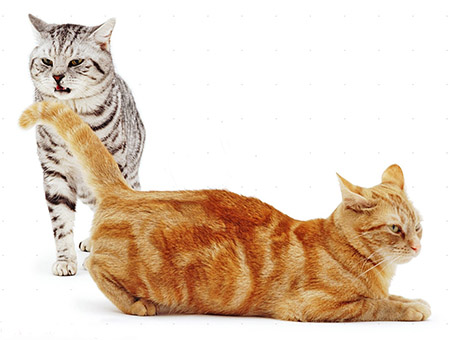
First of all, ovulation is not spontaneous as it is in other species; instead, it is known as induced or stimulated ovulation. This means that while it occurs automatically during each cycle in female dogs and women, in cats the egg cell is released only a few hours after mating.
During estrus, moreover, a female cat may mate many times a day, releasing different egg cells each time. For this reason, a cat with a large number of suitors may give birth to a kitten fathered by each of them.
Another important aspect is that in cats the bleeding that occurs during proestrus in female dogs is absent.
Finally, in cats we speak more precisely of a seasonal polyestrous cycle. This means that, unlike other species, cats are strongly affected by changes in daylight. Starting
in spring and continuing until the first autumn days, female cats have continuous estrous cycles approximately 16 days apart, each lasting at least 5 days.
Estrus stops only if fertilisation occurs, but it may happen that a new estrous phase returns soon after pregnancy.
Heat in animals
Once we have learned all this information, we can therefore say that “heat” is nothing more than the combination of internal events occurring during estrus and the animal’s outward behaviour.
Heat is particularly noticeable in female cats. They become restless and tend to meow continuously, with a very loud sound almost resembling a lament. They roll on the floor, walk crouched low with their hindquarters raised and hold their tail to the side, as a sign of
sexual receptiveness.
In female dogs, on the other hand, behaviour is less spontaneous. More than anything, during walks in the park, they will appear more receptive to other dogs, often turning their hindquarters towards males’ muzzles with their tails held to the side. You will also realise that your dog is in heat mainly because of the presence of a large crowd of suitors beneath your balcony.
How to behave when a female dog or cat comes into heat
If you want to avoid an unwanted pregnancy, supervise them constantly. They might escape or, if they live in a garden, all the males in the neighbourhood could arrive in the blink of an eye.
Avoid keeping the female with an unneutered male. When nature calls, warnings and reprimands are of little use.
One tip to make dealing with bleeding easier is to use special hygiene pants for dogs, avoiding the need to clean the floor several times a day.
If you do not intend to breed your female dog or cat later on, have her spayed. Heat is a stressful event for animals, especially when they are then deprived of the opportunity to mate. Continuing to subject them to this stress “for nothing” would make no sense.