
Understanding a dog’s nonverbal language is essential for an owner. Let’s see how to learn to understand it.
Although our animals cannot speak our language, they can understand what we are trying to communicate simply by listening to the tone of our voice or observing the position of certain parts of the body.
Conversely, we too should make understanding our dog’s nonverbal language an automatic action, so that we can continually strengthen the special bond between humans and their pets.
The aspects of our dog that we must observe above all are the ears, tail, torso, gaze and mouth.
Most common behaviors
There are many gestures and behaviors a dog may use to communicate with other animals or humans. Some of these represent the dog’s basic language, so we should all learn to recognize them in order to understand our animal’s state of mind.
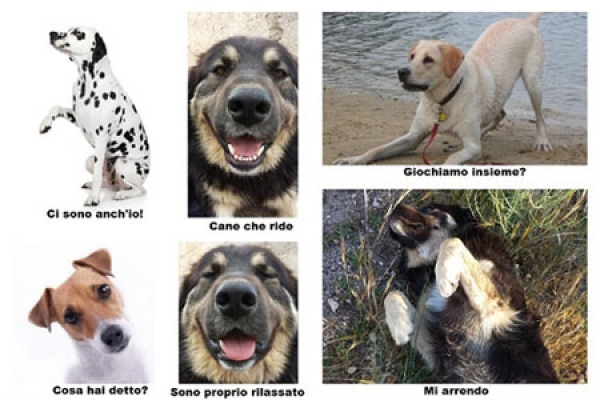
The expressions and gestures of a relaxed or happy dog may include:
-
The dog has relaxed ears and frequently blinks: this is a clear sign of relaxation;
-
The dog has relaxed ears, half-closed eyes and a partly open mouth: this indicates pleasant sensations and submission toward the person in front of it;
-
The dog “laughs”: it is actually smiling, to communicate its affection;
-
The dog tilts its head to one side: it is listening to what we are saying;
-
The dog lies on its back: when the dog shows its belly, it is because it is submitting or expressing complete trust toward the other dog or human;
-
A dog that spontaneously offers its paw: this is a way to attract attention or make a request;
-
The dog licks hands: it wants to communicate its affection;
-
The dog lowers itself onto its front legs and wags with its tail raised: it is greeting you or telling you that it cannot wait to start playing.
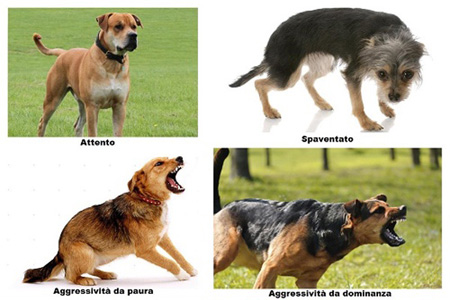 Signs of fear, anxiety or stress include:
-
The dog has its tail horizontal, ears forward, mouth closed and eyes fixed on one point: something has caught its attention, putting the dog into a state of alertness and suspicion. It wants to understand what it is before deciding what to do;
-
The dog has its tail between its legs, ears lowered and mouth closed, with its body low and back: it is afraid, but does not intend to attack;
-
The dog has its tail between its legs, ears lowered and pulled back, teeth bared, fur raised, and pushes its body low and backward: it is afraid, and could attack if provoked;
-
The dog has its tail raised and rigid, wrinkled muzzle, bared teeth, raised fur and projects its body forward: this is a clear sign of dominance aggression;
-
The dog has a horizontal, rigid tail, wrinkled muzzle, bared teeth and a partly open mouth. Its fur is raised and its body is ready to spring: it is very angry and about to attack.
Calming signals
Dogs’ nonverbal language also includes the so-called “calming signals”, meaning all those gestures and postures intended to prevent aggression by other dogs by reducing their level of tension. The main ones are: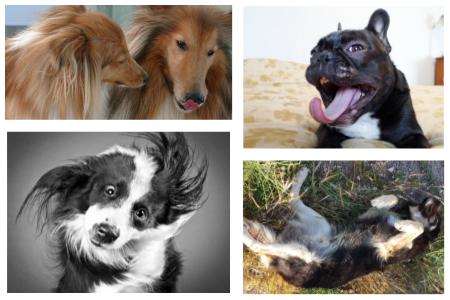
-
Yawning: this is the quintessential calming signal. If your dog starts yawning in front of another dog, it does not mean that it has suddenly become very sleepy, but simply that it is trying to reassure its opponent. Yawning can also be used by the owner to interrupt a puppy’s overly exuberant play or calm it when it is too tense. However, a dog may also yawn to signal boredom, stress or tension;
-
Licking its nose: the dog performs this gesture very quickly and repeatedly on two distinct occasions: when it is calm or when it is apprehensive. In the first case, it does so to communicate its calmness to the other dog or human; in the second, a typical example is a dog waiting for its owner’s command. In this case, the dog is so concerned about understanding and carrying out the command that it enters a state of concentration and apprehension, and demonstrates this by licking its nose;
-
Turning its head away: in this way the dog avoids eye contact with the other dog or human, to demonstrate its peaceful intentions;
-
Turning its whole body away: this is another classic calming signal, also used by the mother to interrupt the puppies’ wild play or demands. Humans can also use this gesture to make their dog understand that it has overstepped the permitted limits;
-
Half-closing its eyes: when the eyelids are lowered, the dog’s facial expression immediately softens, communicating relaxation and submission;
-
Freezing: if our dog freezes in front of another dog, perhaps one larger or more threatening than itself, it means that it is trying to communicate that the other dog should remain calm;
-
Showing its belly: when the dog lies on its back, showing its belly to its opponent, it is clearly declaring its peaceful intentions and its submission;
-
Shaking repeatedly: the dog shakes its entire body, just as it would after a bath, when a stressful event has finally ended;
-
Moving slowly: if we make sudden, rapid movements, the dog may not have enough time to understand our intentions. That is why it is important to move slowly, just as our dog does when it encounters other dogs;
-
Walking along a curved path: two dogs that do not know each other will rarely meet along a direct, frontal path. Instead, they will try to move in a semicircle, so as not to give the impression that they want to attack.
Gestures that the dog may misunderstand
Dogs have their own specific language in nature, which enables them to interact with other animals. For this reason, especially if we do not know the dog in front of us, we should avoid displaying certain gestures and behaviors that the dog may misunderstand. For example:
-
Do not laugh in front of the dog: seeing our exposed teeth, the dog may think that we are growling at it, and react accordingly;
-
Do not immediately bring your hands up to its face: it may become frightened or misunderstand your gesture;
-
Do not hug the dog: in nature, when one dog rests its muzzle on another’s neck, it is because it is asserting its dominance. There are other universally understandable ways to show it our affection;
-
Do not approach too quickly and directly: the dog may interpret this gesture as a clear sign of attack. Instead, move laterally, describing a semicircle, possibly turning your head or merely your gaze to the opposite side.
The best way to approach a dog we do not know is to stand beside its body, without looking it in the eyes. You may then pet the shoulder area, avoiding the head and neck, which are intimate and sensitive areas for the dog. Once you have followed these simple steps, you will have laid the foundations for establishing a relationship of trust with your new friend.